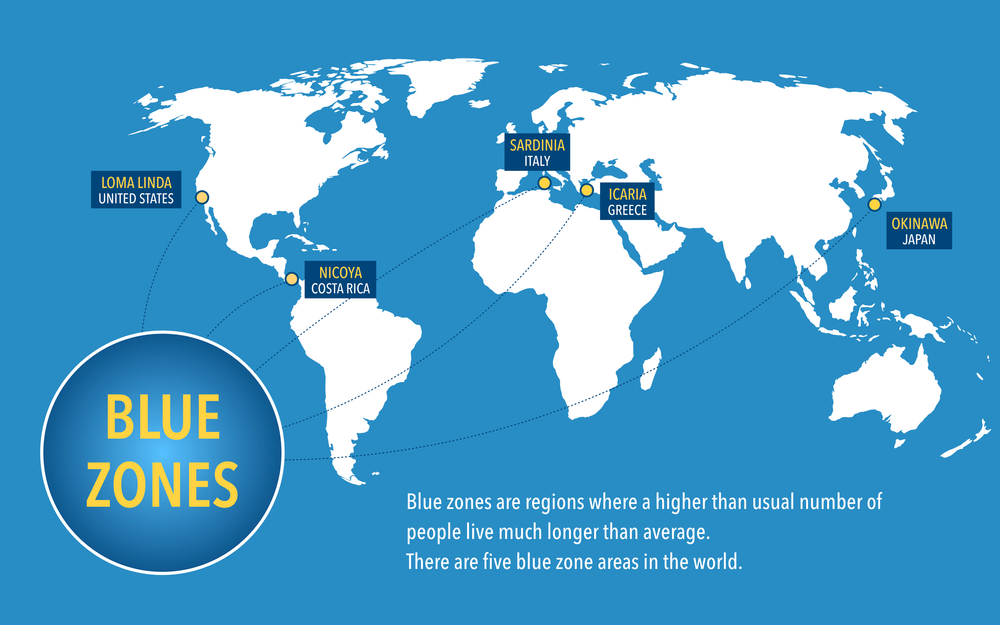
I recently watched the documentary series “Live to 100: Secrets of the Blue Zones” on Netflix. This series follows author Dan Buettner to five different communities around the world where people tend to have longer lives.
In the United States, the average life expectancy (as of 2023) was 78.4 years. For Indigenous peoples in the United States, the life expectancy is about 72.7 years. In the US, the top 5 leading causes of death are heart disease, cancer, unintentional injuries, stroke, and chronic lower respiratory diseases.
Buettner (and the team of researchers and experts he assembled) found that there are 9 basic principles that people in the blue zones who are living way longer than us in the United States follow. As I learned more about these “power 9,” I realized that the Jiwere-Nut’achi traditional lifestyle actually encompasses most of these.
1. “Move Naturally”
Buettner writes, “The world’s longest-lived people don’t pump iron, run marathons or join gyms. Instead, they live in environments that constantly nudge them into moving without thinking about it. They grow gardens and don’t have mechanical conveniences for house and yard work.”
To me, this relates back to Jiwere-Nut’achi traditional lifestyles in that our people used to grow their own gardens, worked the land themselves, and hunted and fished for themselves. Basically, everything was done by hand. Mechanical conveniences only took over as colonization and assimilation did. Our traditional dances burn as many calories as a jog or run at the gym. I’m calling this principle “Manyi re! Ch’ege skunyi re!” – Move, don’t be lazy!

2. “Purpose”
Buettner found that in the blue zones, people knew their purpose for their life. Okinawans (Japan) call it their “ikigai” and Nicoyans (Costa Rica) call it the “plan de vida.” Our Jiwere-Nut’achi ancestors were pretty clear about what constitutes our purpose for being on this Earth, which is to take care of one another and ensure that our ways are passed on from generation to generation. If you are living to serve your people, you know what your purpose is. However, if you are just existing in the world as an American capitalist, your purpose may not seem so clear. I think the word “Irugrą” fits best for purpose because it can mean to have a will to do something, to plan, to decide.
3. “Downshift”
We know that chronic stress puts our health at risk. Stress can cause problems with chronic inflammation, anxiety, depression, digestive problems, headaches, muscle tension and pain, heart disease, heart attack, high blood pressure and stroke, sleep problems, weight gain, and problems with memory and focus. Buettner points out that even people in the blue zones experience stress but it is their response to stress that makes them different. Essentially, they have built-in routines in the day that help them alleviate some of the stress that all of us experience.
For example, “Okinawans take a few moments each day to remember their ancestors, Adventists pray, Ikarians take a nap and Sardinians do happy hour.” So I asked myself, what do we as Jiwere-Nut’achi people do to alleviate stress that is traditional and original to us? We “gi’thu” – we think about and remember our ancestors, like the Okinawans. Like the Adventists, we pray – “waroxi.” We also know that “Ruhįnje” – appreciating and giving thanks, “I’sha” – laughing and smiling, “Ugisą” – helping and assisting, all help manage stress.
4. “The 80% Rule”
The fourth principle posited by Buettner is drawn from the “2500-year old Confucian mantra” ‘Hara hachi bu’ recited in Okinawa before meals. It is meant to remind them to “stop eating when their stomachs are 80% full.” Buettner writes, “The 20% gap between not being hungry and feeling full could be the difference between losing weight or gaining it.
People in the blue zones eat their smallest meal in the late afternoon or early evening and then they don’t eat any more the rest of the day.” We often hear that breakfast is the most important meal of the day. In the United States, according to a 2024 USDA data brief, “85% of adults consume breakfast…with a higher prevalence among those 60+ years relative to those <60 years.”
Additionally, “Breakfast prevalence is higher among adults with family incomes >130% of the poverty level relative to those below that level.” The study cited in the data brief found: Approximately one in five adults obtains more than 30% of their daily energy intake from breakfast; Compared to non-consumers, breakfast consumers have higher intakes of energy and nearly all nutrients studied; Among consumers, breakfast account for an average of 21% of energy intake and comparable amounts of most nutrients; The food category most commonly consumed at breakfast is grain products, and the most commonly consumed beverage is coffee.
Our Jiwere-Nut’achi ancestors relied on grains like wild rice and amaranth but consumed dried meats mixed with berries and nuts as well. They had vastly different diets than what we tend to eat today, i.e. Eggs, bacon, sausage, pancakes, cereal, etc. One way that we can help ourselves today is to think “warujesdą’į wiranąnje ke/ki” – stop eating when you’re full.
5. “The Plant Slant”
Buettner writes, “Beans, including fava, black, soy and lentils, are the cornerstone of most centenarian diets. Meat—mostly pork—is eaten on average only five times per month. Serving sizes are 3-4 oz., about the size of a deck of cards.” Think about how many times this week you have eaten meat, and what types of meat that you ate. Factory farmed meat has its fair share of problems which you can read more about here.
Prior to assimilation, our Jiwere-Nut’achi ancestors relied on bison hunts and wild game such as deer, elk, turkey, small fowl, and fish for meat. They also ate their own varieties/cultivars of “unyi” (beans), “wadwą” (squash), and “waduje” (corn). They also drank “xami mąnką” (tea) and ate greens that are commonly treated as weeds today such as lambsquarters and dandelion greens. Other greens include sorrel, stinging nettles, and watercress. They harvested root vegetables such as wild potatoes, turnips, and sunchokes.

6. “Wine @ 5”
In the US, we struggle with the concept of moderation. We live in an “All or Nothing” society which asserts that you either have to be totally abstinent from alcohol or it encourages you to engage in binge-drinking (which is a form of alcoholism). Buettner writes, “People in all blue zones (except Adventists) drink alcohol moderately and regularly. Moderate drinkers outlive non-drinkers. The trick is to drink 1-2 glasses per day (preferably Sardinian Cannonau wine), with friends and/or with food. And no, you can’t save up all week and have 14 drinks on Saturday.”
Prior to colonization, Indigenous people in the Americas had a variety of fermented drinks that were generally only used in spiritual ceremonies and was done so with the intent of improved well-being of community rather than an individual person’s enjoyment. Alcohol as we know it today was often introduced into our communities as a tool to gain advantage of us during trade. Alcoholism that exists in our society today is a feature of American capitalism and not the fault of individuals. In short, American society has a poor relationship with alcohol which is very obvious when we travel to other countries.
Buettner specifically suggests Sardinian Cannonau wine because it is higher in antioxidants and polyphenols. Antioxidants help protect your cells from damage by free radicals, which helps lower the risk of chronic diseases like cancer, heart disease, and diabetes, improves skin health, and supports brain and eye health. Specifically, the Sardinian Cannonau wine contains resveratrol, an antioxidant found in the skin of the grapes used to make the wine. For more information about how resveratol can be good for longevity, click here. For this principle, I think the phrase “Pehnyixgu dokira rahdą pi ki. Nu’ą rohą skunyi ki.” fits here. A little bit of wine is good but not a lot!
7. “Belonging”
Not all of the centenarians that Buettner interviewed were members of faith-based communities but the overwhelming majority were. Buettner writes, “Denomination doesn’t seem to matter. Research shows that attending faith-based services four times per month will add 4-14 years of life expectancy.” I think this ties back to our Jiwere-Nut’achi people very easily. Jiwere itself means those belonging to the people of the land or with their own people.
There is something about belonging to a group that believes the same things that keeps us present in this life. These communities foster a sense of belonging and camaraderie among members which can alleviate feelings of loneliness and isolation. Such communities have regular gatherings, events, and services. As mentioned above, things like prayer, meditation, and communal rituals have positive emotional and mental health benefits that help us face life’s stresses and challenges. Often, being part of a faith community can help people find their purpose in life.
Prior to colonization our Jiwere-Nut’achi ancestors had a rich cosmology that went beyond the belief of one singular God as it is conceptualized in Christianity. Elements of our beliefs were adapted to Christian practices and structures because our traditional ways were outlawed until the American Indian Religious Freedom Act was passed in 1978. But by that time, many of the ceremonies and original beliefs we had were lost to time.
8. “Loved Ones First”
In blue zones, aging parents and grandparents are kept close, nearby or in the home. Buettner writes that it lowers disease and mortality rates of children in the home too. This is a principle that I think many Indigenous communities identify with. Family is extremely important to us. Buettner points to finding a partner with which to spend their life (adding 3 years to life expectancy) and really taking care of and loving one’s children (they might feel more obligated to take care of YOU when the time comes) as things that were seen in blue zones. Check out this handout about child development and this short article about a study on Indigenous perspectives on aging. “Chuyu pagrą” = Family First.
9. “The Right Tribe”
Lastly, the oldest people in blue zones either chose or were born into what Buettner terms the “Right Tribe.” He writes, “Okinawans created ‘moais’–groups of five friends that committed to each other for life…the social networks of long-lived people have favorably shaped their health behaviors.” If the people you surround yourself with engage in a lot of unhealthy behaviors, whether its drinking to excess, smoking, eating poorly, etc, you are likely to have those same behaviors which will inevitably lead to a shorter lifespan. In the past, our Jiwere-Nut’achi ancestors had their families, their clans, and sometimes belonged to a specific lodge or society called a “wokigo.” This same idea persists today as different organizations like the War Mothers, Gourd Clans, Veterans groups, etc. but also in the groups of friends that we go through life with.
I hope this post inspires more of us to think traditionally and Indigenously when we think about how we move through our days, connect with others, and decide what and how to consume food and drinks.
Wapana ha! (May you have good health!)